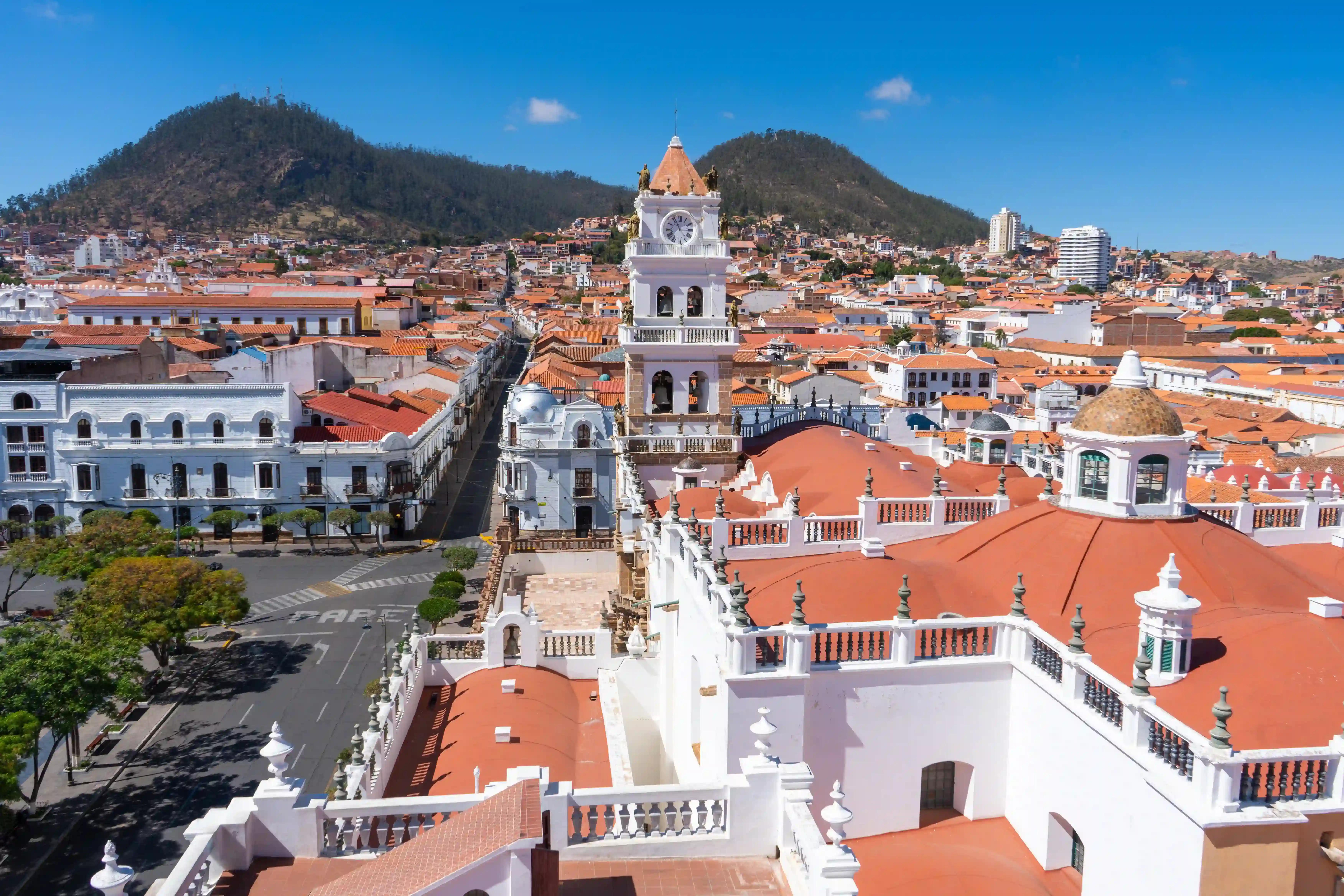
Sucre is Bolivia's constitutional capital and one of the best-preserved colonial cities in South America. Founded by the Spanish in 1538 as La Plata, the city grew wealthy from the silver extracted at nearby Potosí and was rebuilt in an elegant Baroque and neoclassical style. The entire historic centre was declared a UNESCO World Heritage Site in 1991. Painted entirely in white — the colour law has been enforced for centuries — Sucre is known throughout Bolivia as La Ciudad Blanca, the White City. It sits at a comfortable 2,750 metres, well below La Paz, with a spring-like climate throughout the year and a relaxed pace of life that makes it one of the most pleasant cities in the Andes.
The historic centre
The heart of Sucre is the Plaza 25 de Mayo, a wide colonial square flanked by the Metropolitan Cathedral, the city's governor's palace, and a ring of white arcaded buildings. The square marks the symbolic birthplace of Bolivian independence: it was here, and in the Casa de la Libertad just off the plaza, that Bolivia declared independence from Spain in 1825. The Casa de la Libertad is now a national museum housing the original Declaration of Independence and portraits of the liberators. A walk outwards from the plaza through the grid of white streets, Baroque churches, and flowering courtyards takes most of a morning and repays slow, unhurried attention.
Cal Orck'o — the dinosaur wall
Five kilometres from the city centre lies one of the most remarkable palaeontological sites on Earth. Cal Orck'o is a near-vertical limestone cliff face containing more than 5,000 individual dinosaur footprints from at least 294 different species, dating back 68 million years. The tracks were exposed by cement quarrying and include the longest known sauropod trackway in the world. The site is now managed as an open-air park with guided access and life-size dinosaur models placed along the trail. It is completely unlike any other attraction in Bolivia and is genuinely extraordinary up close.
Museums and markets
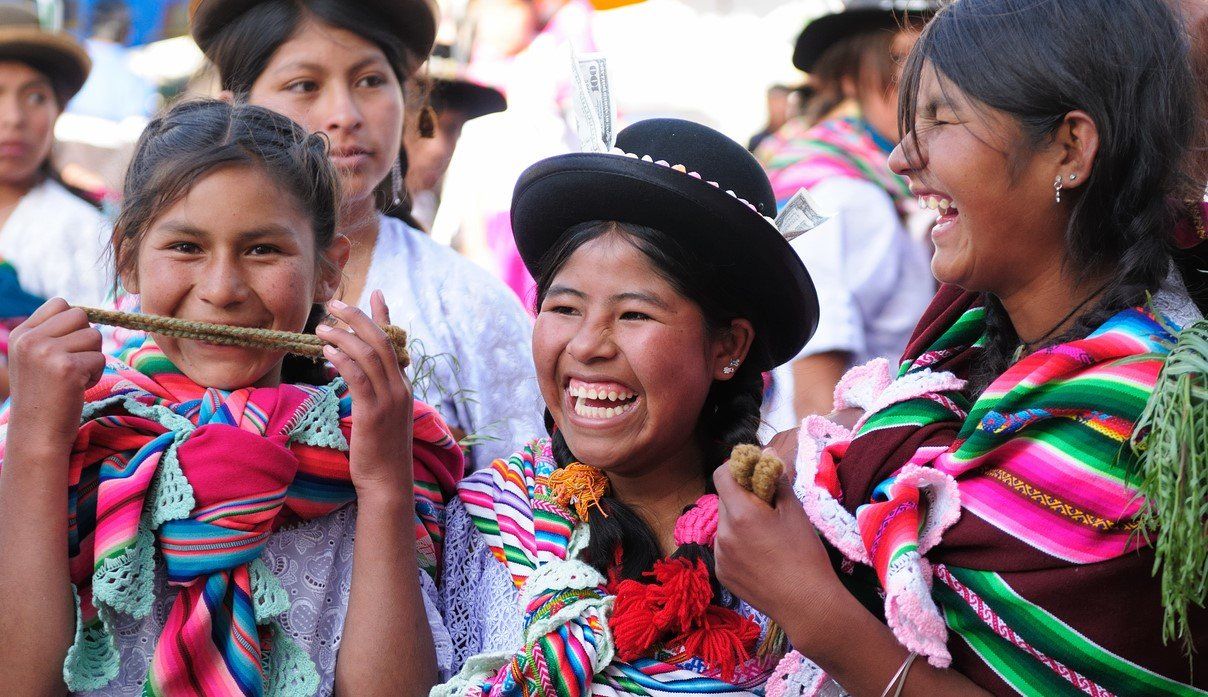
Sucre's colonial buildings house an unusually fine set of museums for a city of its size. The Museo Asur documents the development of traditional textiles in the region. The Recoleta viewpoint, perched on a hill above the city, offers panoramic views across the white rooftops. Visitors can also walk up to the roof of the tower of the San Felipe Neri Church and visit the local Indian market to understand the local folklore.
Visiting with Undiscovered Destinations
Sucre is a highlight of our 15-day Bolivia – From the Lowlands to the High Andes tour, which spends one night in the city and includes a guided tour of the historic centre, the Museum Casa de la Libertad, Museo Asur, and a visit to Cal Orck'o. The tour is priced from £3,295 per person with guaranteed departures from just two travellers. Sucre also features in our 28-day Argentina, Chile and Bolivia Explorer, which combines it with a full crossing of the Atacama Desert, the Chiquitania Jesuit missions, and the Uyuni Salt Flats. For travellers wanting a tailor-made Bolivian itinerary, we can build a route using Sucre as a base for day trips to Tarabuco and Potosí. See our Bolivia destination page for all available tours.